
PACKSTAFF, LLC
2026 Packaging Engineering Career Survey
How to Read This Summary
This executive summary is intended to provide orientation, not exhaustive analysis.
It reflects patterns observed across responses to the 2026 PackStaff Packaging Engineering Career Survey and focuses on how packaging engineering work is experienced today.
The goal is to surface recurring signals and tensions that shape workload, hiring, compensation, and career movement across the field.
This summary does not claim statistical representativeness beyond the survey sample. Where experiences vary, that variation is treated as a signal rather than noise.
The Current State of Packaging Engineering Work
Packaging engineering work sits at the intersection of technical execution, organizational constraint, and accelerating change. While the function is widely recognized as critical to product performance, cost, sustainability, and speed to market, the day‑to‑day reality of the work is often poorly understood outside the teams doing it.
This executive summary draws on responses from the 2026 PackStaff Packaging Engineering Career Survey to describe how packaging engineering work is currently being experienced across roles, industries, and career stages. The intent is not to benchmark companies or offer prescriptive solutions, but to surface recurring patterns in workload, pressure, and constraint as described by respondents themselves. The findings that follow are meant to provide orientation and shared language for understanding the conditions shaping packaging engineering work today.
Section 1: Workload Pressure and Capacity
Core question: What does day‑to‑day packaging engineering work actually feel like right now?
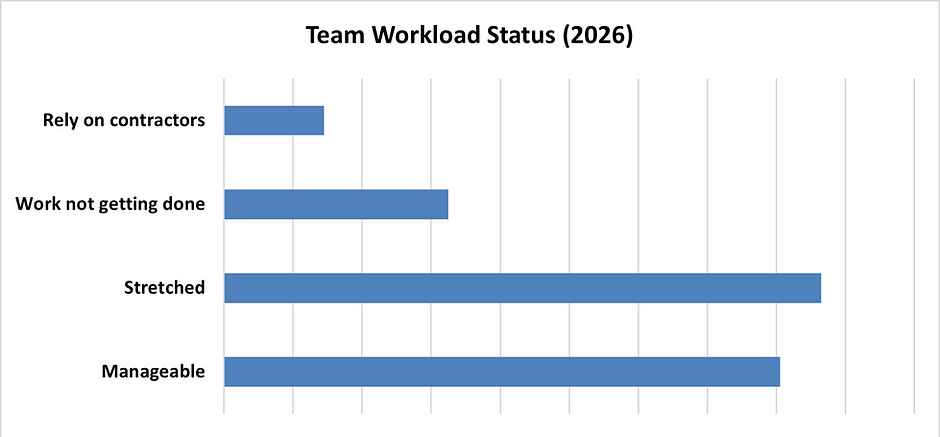
Across responses, workload pressure emerges as real but uneven. Some engineers describe manageable, well‑scoped roles with clear priorities. Others report stretched capacity, shifting expectations, and work that routinely goes unfinished.
Respondents consistently rank team bandwidth, budget limits, and speed‑to‑market demands as the most significant constraints shaping day‑to‑day work.


While these pressures are often framed as resourcing or financial issues, open‑ended responses and follow‑up comments suggest they are rarely isolated problems. Instead, respondents describe constraints that stem from how work is scoped, sequenced, and decided. Late‑stage changes, compressed timelines, and limited ability to influence packaging decisions earlier in the process frequently intensify these pressures.
What these constraints look like in practice
When these constraints stack, adding tasks or responsibilities does not translate into increased output. Respondents frequently describe work that expands in scope without a corresponding increase in clarity, authority, or sequencing. As a result, time and effort are often absorbed by rework, coordination, and recovery rather than forward progress.
This is reflected in how respondents describe where their teams spend the majority of their time and energy. Rather than concentrating on a small number of clearly prioritized initiatives, many teams report being spread across competing demands that change quickly and are difficult to control.
Across experience levels and industries, this distribution reinforces a consistent theme. Capacity is consumed not only by volume of work, but by fragmentation, late changes, and limited influence over when and how packaging work enters the process.

Voices from the survey
Open‑ended responses reinforce this pattern. Across experience levels, respondents describe pressure driven less by effort and more by timing, instability, and limited influence earlier in the process
“Headcount reduction without workload reduction has led to increased pressure and limited ability to keep up.”
"Ineffective and passive management. Lack of ownership and accountability across teams. Work is often pushed onto individuals without proper direction or support. Poor communication and follow-through. Inefficient processes that slow down even simple tasks."
“The workload continues to increase, but priorities change frequently, which makes it difficult to complete work efficiently.”
"… The work is often exhausting due to a lack of consistent processes and alignment across projects. There is high turnover, which creates instability and additional workload for those who stay.”
“I enjoy the work itself, but the workload and constantly shifting expectations create ongoing strain.”
These comments do not point to isolated issues or individual performance challenges. Instead, they reinforce a structural pattern in how packaging work is scoped, handed off, and revised.
Why this distinction matters
Understanding workload pressure as a structural issue, rather than simply a resourcing problem, helps explain why common responses often fall short. Effort, experience, or additional tasks alone do not resolve strain when priorities are unstable and decision rights are limited.
This distinction sets important context for the sections that follow, particularly discussions of hiring, retention, and compensation. Without changes to how work is defined and sequenced, pressure tends to persist even as teams adapt and individuals work harder.